
If Daraba Doesn't Mean Strike, Then What Does the Quran Mean Anywhere?
Wife Beating in Islam, the Word Daraba, and the Domestic Violence Crisis No Rebranding Can Solve

Quran 4:34 was the verse I struggled with most when I still practiced Islam. Not because I misunderstood it. Because I understood it exactly.
As a young physician in Pakistan, my professors would treat women who came in carrying the evidence of a marriage on their bodies and minds. They wondered if what was done to them was a consequence of their disobedience.
My professors would counsel them. They would tell some of them that their husbands had misapplied the right because the disobedience had not been severe enough to warrant it. I would ask them, what is severe enough disobedience?
I received a hundred answers from a hundred people. None of them agreed.
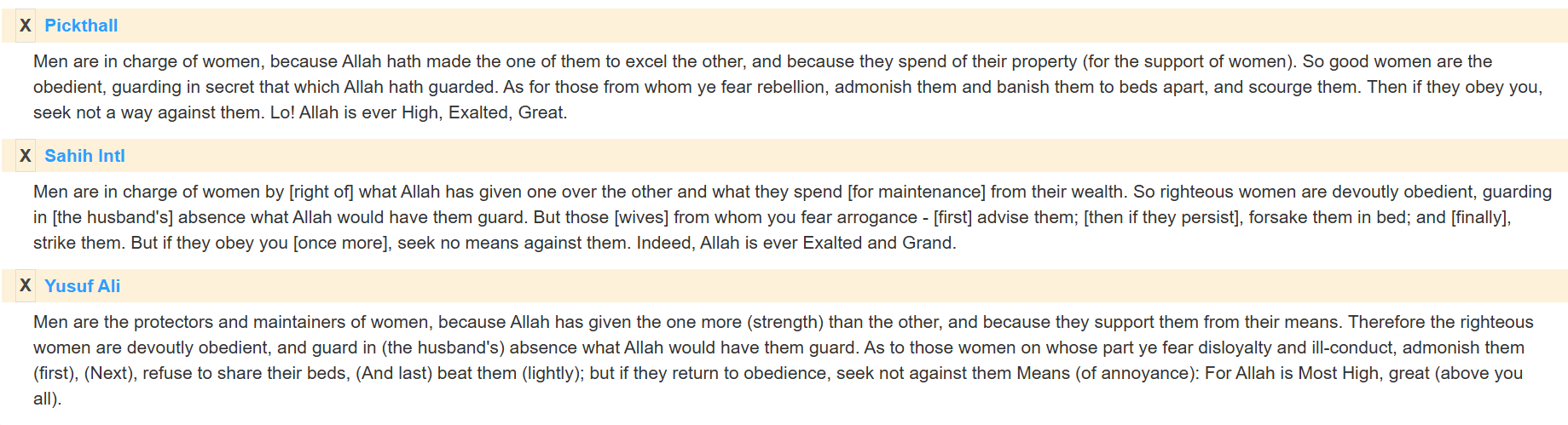
It was only after I left Islam, only after I became detached enough from the faith, that I was able to call a spade a spade. The verse does not need rescuing. It needs reckoning.
And so when I encounter the current wave of online apologetics insisting that the Arabic word daraba in Quran 4:34 does not mean ‘strike’ at all, that it means ‘walk away,’ ‘separate,’ ‘go on strike like a worker,’ or ‘tap lightly,’ I am not confused. I am watching a tradition perform emergency surgery on its own text because the original reading became internationally embarrassing.
If daraba does not mean ‘strike’ in 4:34, then what does it mean everywhere else in the Quran? That is not a rhetorical question. It has a precise, testable answer.
1. What Does Daraba Mean in Quran 4:34? Examining the Claims
Modern reinterpretations of Quran 4:34 tell us that waḍribūhunna, the third step in a sequence for dealing with a wife’s nushuz, does not mean what the entire classical tradition understood it to mean.
We are told it could mean: ‘walk away from them,’ ‘separate from them,’ ‘go on strike,’ ‘strike the contract,’ ‘tap lightly,’ ‘a symbolic gesture, perhaps with a toothbrush.’ Some have floated ‘set an example’ or ‘distance yourself emotionally.’
These proposals do not come from new manuscripts, from newly recovered Arabic lexicons, or from discoveries in the tafsir literature. They come from social media threads, from people defending their faith against criticism, and from a small number of reformist scholars working backward from ethical conclusions they find more acceptable.
It is damage control. If indeed God just wanted the husband to walk away or settle, it could have been as simple as the instructions for a wife to settle with a Nushuz husband because “settlement is best.” It was not.
That said: the linguistic claim deserves a direct answer, not just a dismissal. Daraba is a polysemous root. It does appear in the Quran with multiple meanings. The question is whether those meanings are interchangeable across grammatical contexts.
Polysemy is not a magic wand. The fact that a root has many meanings does not mean every meaning is available in every verse. If it did, Moses staged a labor strike against a rock, angels went on strike against faces and backs, and Job was told to solve a sworn oath by gently parting ways with a bundle of grass.
2. The Three-Step Escalation in Quran 4:34
Before the linguistic evidence, there is a structural problem that alone should end the ‘walk away’ argument.
Quran 4:34 prescribes a three-step response to nushuz: Admonish them (faʿiẓūhunna), Separate from them in bed (wahjurūhunna fī al-maḍājiʿ), Waḍribūhunna.
This is an escalation. Each step is supposed to be more serious than the last. Advice yields to withdrawal. Withdrawal yields to something beyond withdrawal.
Now substitute ‘walk away’ into Step 3:
1. Advise them. 2. Separate from them. 3. ...separate from them again.
Step 2 is already withdrawal. If Step 3 also means withdrawal, the verse has used two entirely different Arabic verbs to convey an identical action. The sequence does not escalate. It stutters. If step 3 is divorce, there are specific words for it in Arabic (Talaq).
No Arabic rhetorician, no jurist, no linguist working in the pre-modern period read the verse this way. The reading makes the text incoherent. The ‘walk away’ interpretation does not rescue 4:34. It destroys its internal logic.
3. Testing the Meaning of Daraba Across the Quran
If for each proposed alternate meaning of daraba, we insert it into every comparable Quranic verse: those where the same root appears with direct physical objects and no qualifying phrase. The criterion is not theological preference. It is whether the sentence retains meaning.
3.1: Quran 47:27: Striking Faces and Backs (Closest Parallel to 4:34)
Arabic construction: yaḍribūna wujūhahum wa-adbārahum
This is the verse about angels punishing hypocrites, acting directly on human bodies. In the classical meaning, it includes physical striking of faces and backs. Direct object is human body parts. No qualifying phrase.
If we apply the same alternate meanings for the same word, it would translate to “angels walking away from their faces and back,” “angels going on a labor strike,” or “angels tapping them lightly.”
3. 2. Quran 8:12: Strike Above the Necks
Arabic construction: iḍribū fawqa al-aʿnāq
In the Battle of Badr; angels commanded to strike enemy combatants. Classical meaning is a lethal physical blow to the neck. If we apply the apologetic meanings, it would mean “walk away from above their neck,” “labor strike above their neck,” or “tap lightly above their neck.”
3.3. Quran 47:4 — Striking the Necks
Arabic construction: fa-ḍarba al-riqāb
This verse gave war directive regarding enemy combatants. Classically, it was translated to a forceful blow, often understood as decapitation.
If we apply the “alternate meaning” of the same root word, it translates to “walk away from the necks,” or “light tap on the neck.” Labor dispute doesn’t enter into a battle field.
3.4. Quran 8:50: Striking Faces and Backs
Arabic construction: same as 47:27
This verse speaks about angels taking souls of disbelievers at death. It was classically translated to physical striking of the body.
Walking away, labor strike, light tapping, divorce, none make sense.
3.5. Quran 2:60: Strike the Rock
Arabic construction: iḍrib bi-ʿaṣāka al-ḥajar
This verse talks about when Moses was commanded to strike a rock; water flows. This was understood as a physical strike producing a physical result.
If the alternate meaning is used, God instructed Moses to walk away, or go on a strike against the rock, or lightly tap the rock with a tooth brush, or hi-five the rock.
3.6. Quran 38:44: Strike with It (Bundle of Grass)
Arabic construction: iḍrib bihi
This verse speaks about Job fulfilling an oath .without striking directly. It is important because it provides a workaround: a way to technically fulfill the oath while minimizing its impact.
The verse does not redefine the act. The verb remains the same, but the instrument is specified, and the result is a reduced, symbolic form. Even a wife like Job’s, who stayed devoted to her husband for years when he was sick, was not spared when he regained health because the oath was more important than putting an end to violence.
This matters for interpretation. If daraba meant “walk away,” “separate,” or any non-physical action, this verse would not function. The instruction only makes sense if the underlying act is understood as physical.
More importantly, when the Quran intends to limit how daraba is carried out, it provides that limitation explicitly. Instrument is defined explicitly. In 4:34, no such qualifier is given. The severity and method is left open ended on discretion of the husband.
3.7. Quran 24:31: Draw Their Covers (Apologists’ Favorite)
Arabic construction: wal-yaḍribna bi-khumurihinna ʿalā juyūbihinna
This verse contains modesty instruction for women. It has classically been translated as draw/extend covers over the chest.
Once again, this is where the word that follows the verb dictates the meaning. This meaning depends entirely on bi (with) + khumur (covers) + ʿalā (over). Remove that structure, and the “cover” meaning disappears. Quran 4:34 contains none of this scaffolding.
3.8. Quran 4:101: Travel in the Land
Arabic construction: ḍarabtum fī al-arḍ
This verse talks about shortening prayer during travel. “Darabtum” is followed by “ard” which is earth. It is an Arabic idiom and not interchangeable with 4:34.
If we replace the alternate meanings in this, whether it is labor strike or lightly tap, it would not make sense since it is an idiom.
3.9. Quran 14:24 / 16:75: Set Forth a Parable
Arabic construction: ḍaraba Allah mathalan
In these verses, daraba is translated as “set forth” or “present an example.” But that meaning doesn’t come from the verb alone. It comes from what follows it.
The word mathalan means “example” or “parable.” When paired together, ḍaraba mathalan, they form a fixed expression: to present an example.
That detail matters. Because in 4:34, that structure is not there. The object is hunna, “them,” referring to wives, not an example. The phrase that produces the meaning “set forth” simply does not exist in that verse.
And if you try to force alternate meanings here, “walk away from the example,” “tap the example lightly,” the sentence stops making sense entirely.
3.10. Quran 4:34: The Verse in Question
Arabic construction: waḍribūhunna
This verse describes Step 3 in sequence: advise → separate in bed → waḍribūhunna
Classically, it was translated as physical striking. The restrictions on severity were derived from Hadith literature. There is consensus across all four Sunni schools and major tafsir traditions.
Multiple English translations of Quran 4:34 from the 18th to 20th centuries consistently render daraba as “beat,” “strike,” “scourge,” or “chastise,” showing a strong historical consensus in interpretation. Classical tafsir sources, including Ibn Abbas and Al-Jalalayn, also understand the verse as permitting physical discipline, while emphasizing that it should not be severe or violent. Pre-modern scholars and translators, working long before modern reinterpretations, understood the term in a literal physical sense, and that contemporary attempts to reinterpret it as non-physical are inconsistent with that tradition.
When daraba takes a direct physical or human object without a qualifying phrase, it means impact: force applied to a surface or body. The other meanings (travel, example, drawing cloth over) are each produced by specific grammatical scaffolding that is absent in 4:34.
On Ghamidi discussion forum it is argued that specifically because there are no qualifiers, 4:34 cannot mean physical striking. The argument assumes that physical striking must always be explicitly qualified, but Arabic does not work that way. When daraba takes a direct human object without a particle, the meaning is already established. Qualifiers may limit the act, but their absence does not change its nature.
Note also that 47:27 and 8:50 use virtually the same construction as 4:34, the same verb, third-person plural, acting directly on human bodies. They mean exactly what the word always means in that configuration: striking.
4. Misconceptions About the Meaning of Daraba in Quran 4:34
The screenshots driving this piece are not fringe views. They represent the standard repertoire of online apologetics on this verse. Each deserves a precise response.
‘Daraba means a labor strike or ‘strike from record’ in the original context’
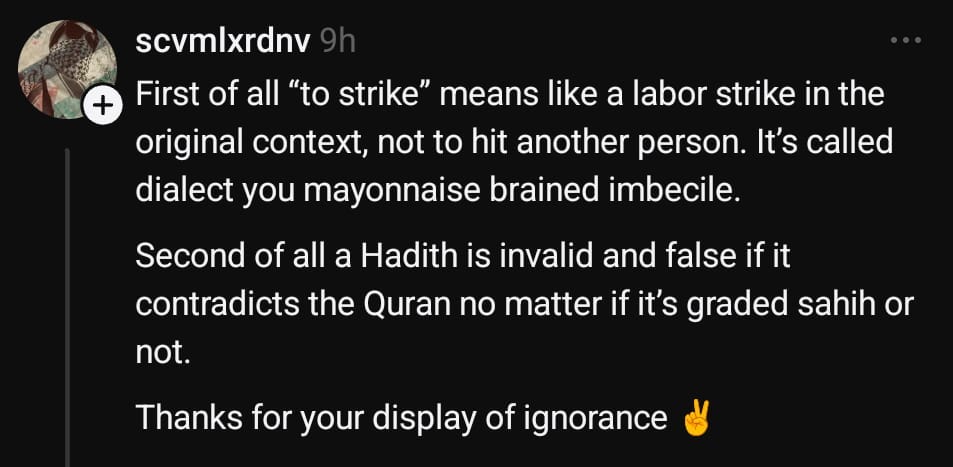
A labor strike is a modern socio-economic concept tied to industrial capitalism, organized wage labor, and collective bargaining. The term entered Arabic in its modern sense with the labor movements of the late 19th and 20th centuries. No classical Arabic lexicon, Lane’s, Lisan al-Arab, al-Qamus al-Muhit, attests this meaning for daraba in the pre-modern period. None.
‘Striking from record’ meaning divorce is another common apologetic. Quran has a clear word that it has repeatedly used for divorce. It has an entire chapter dedicated to divorce. It would be strange to not use the established word if that was the intention.
More importantly: the grammar of 4:34 forecloses the reading. The construction is waḍribūhunna. ‘Daraba them,’ with wives as direct object. A labor strike is not action taken on a person as direct object. It is withdrawal from an employer. These are structurally opposite. The person invoking ‘dialect’ to explain this has confused etymology with grammar.
‘A hadith is invalid if it contradicts the Quran, no matter how it’s graded’
This principle is deployed selectively, applied only when hadith embarrasses apologetics, never when it supports them. Some insist on the fringe Quranist position. Others talk about context.
The deeper problem is that the hadith record on 4:34 does not contradict the Quran. It extends it. It regulates the practice. ‘Do not strike the face.’ ‘Do not cause injury.’ ‘The best of you do not strike their wives.’ These are restrictions on a permitted act, not abolitions of it. You cannot regulate a practice you believe was never permitted.
If discarding the entire authenticated hadith corpus is the price of rescuing a single verse from its historical meaning, the problem is not the hadith.
‘Daraba has so many meanings’
Complexity does not equal flexibility without limit. No reputable Arab linguist, whether classical or contemporary, holds that a polysemous root’s meanings are freely interchangeable across grammatical contexts. The details above is the Quran’s own verses, with the proposed alternate meanings substituted in. The resulting sentences either make sense or they do not. Most do not.
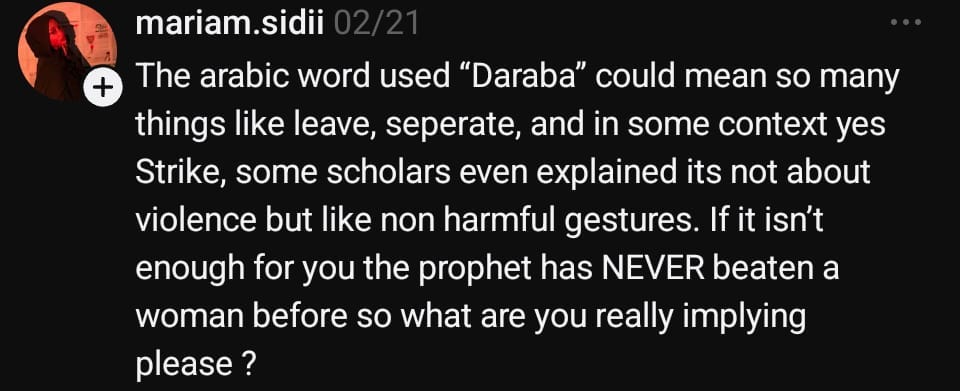
‘The Prophet never struck a woman, so the verse cannot mean striking’
The report that the Prophet never struck a woman or servant with his hand appears in multiple collections. It does not prove what apologists claim. Personal restraint is not legal abolition. The same transmitted tradition that records the Prophet’s restraint also records him allowing physical discipline and striking as detailed below. It also records the Prophet shoving his wife in the chest which caused pain but somehow was not considered hitting.
These are not the accounts of a tradition that understood waḍribūhunna as ‘walk away.’ They are the accounts of a tradition managing the consequences of a permission.
‘Scholars themselves disagree that Daraba means hitting’
This is actually a sharp argument. It often comes from someone defending the traditional reading. The point stands: if the Quran claims to be clear (12:2, 16:89, 15:1) and yet its central disciplinary verse for marriage has required fourteen centuries of jurisprudential qualification, the problem is not the critics. The problem is the text.
Most classic scholars were not confused about the meaning of Daraba. It is only in the modern apologetic times that alternate fringe opinions have surfaced. The fringe modern feminist interpreters will be laughed out of most mosques.
5. What the Hadith Say About Daraba in Quran 4:34
The hadith on 4:34 is the historical record of how the verse was understood, lived, and regulated by the generation closest to its revelation. Setting it aside when it is inconvenient is not honest exegesis.
The permission-restriction sequence (Sunan Abu Dawud 2146)
The sequence in Abu Dawud is significant precisely because of its internal tension. The Prophet initially discouraged striking wives. Umar then came and reported that women had grown ‘emboldened.’ The word implies they were now resisting. Permission was then granted. Women subsequently arrived in large numbers at the Prophet’s household to complain about their husbands’ beatings. The Prophet responded: ‘Those men are not the best among you.’
That is moral disapproval coexisting with legal permission. It is a religious leader uncomfortable with a permission the tradition understood itself to possess.
The Farewell Sermon
The Farewell Sermon material preserved across hadith collections records the Prophet addressing husbands: if wives behave in a certain way, they may ‘beat them, though not severely.’ The verb used is from the same root. Whatever the precise transmission history of the Sermon, those who transmitted it understood the verse as legal permission for physical discipline, precisely the classical reading now being rebranded away.
Sahih al-Bukhari 5825
Aisha is reported as saying she had never seen women suffer as much as the believing women. She said this after observing bruising on a woman caused by her husband. This is not a report from a civilization that had discovered a non-contact reading of 4:34. It is testimony from inside the tradition about the real consequences of the permission the tradition recognized.
6. Does Daraba Mean a “Light” or “Symbolic” Strike in Quran 4:34?
Among the most revealing apologetic moves is the ‘light beating’ argument: daraba permits only a symbolic gesture, perhaps with a miswak, causing no pain and leaving no mark.

This is an admission, not a defense.
The moment the debate shifts to ‘how hard may the striking be?’, the reinterpretation has already stopped working. You cannot argue simultaneously that daraba means ‘walk away’ and that daraba permits only a gentle tap. These are mutually exclusive positions.
The ‘light beating’ argument also reveals what the classical scholars were actually doing. They were placing restrictions on a permission they recognized as real, Ibn Kathir (ḍarb ghayr mubriḥ, a non-severe strike), al-Qurtubi (no face, no injury), the Hanafi jurists (symbolic fulfillment with a folded cloth). The jurisprudential tradition spent centuries on how, not whether.
I recently also came across a self proclaimed online preacher who was insisting that 4:34 does not allow physical harm. When a woman asked why is the wife not given the same allowance, he responded with “be practical, how many wives are physically capable of harming the husband?”
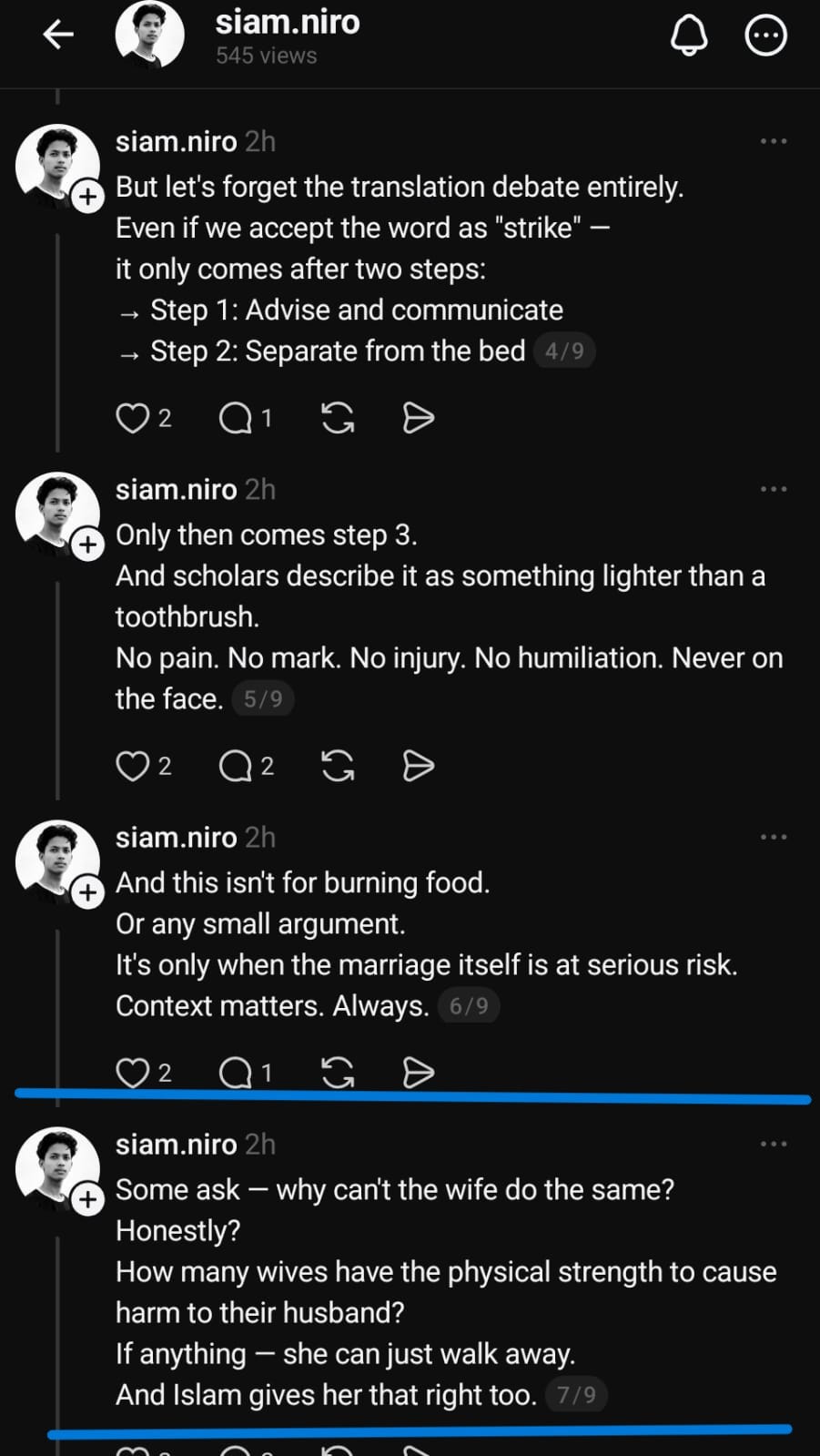
Once you are arguing about the acceptable force of a sanctioned blow, whether fist, folded cloth, or toothbrush, you have already conceded the central point: the tradition did not read the verse as ‘walk away.’
7.Domestic Violence in Muslim Societies and the Impact of Quran 4:34
Online debates about whether daraba means ‘walk away,’ ‘go on strike,’ or ‘tap with a toothbrush’ are not ending domestic violence. They are managing optics.
The real problem is not one verb. The real problem is a moral and legal infrastructure in which male disciplinary authority over women was normalized by scripture, systematized by jurisprudence, and is now being rebranded online for international audiences while remaining structurally intact on the ground.
The data makes this visible.
7.1. Domestic Violence in Pakistan
The Pakistan Demographic and Health Survey (2017-18) found that approximately 43% of women and 38% of men considered wife-beating justified. These are norm statistics. They describe what people believe a husband is entitled to do.
The same survey found that 34% of ever-married women in Pakistan reported experiencing spousal violence. In Khyber Pakhtunkhwa the figure reached 57%. Conviction rates for domestic violence cases in Pakistan currently sit below 2%.
I have worked in the Pakistani medical system. I have seen what those numbers look like in a ward. They are underreported and the bruises are not metaphors.
7.2. Domestic Violence In The Arab world
A scoping review published in Frontiers in Psychology (2023), covering 151 studies across 11 countries including Egypt, Iran, Iraq, Jordan, Lebanon, Saudi Arabia, and Yemen, found lifetime prevalence of physical domestic violence ranging widely, with the highest figures reported from Turkey (89.3% lifetime prevalence of any domestic violence) and Jordan (98% reporting violence in the previous 12 months in one survey). Iran’s estimated domestic violence prevalence stands at approximately 66%, with regional figures reaching 70% in eastern provinces.
A study in Lebanon found that up to three-quarters of Lebanese women had experienced physical violence at the hands of husbands or male relatives at some point in their lives.
7.3. Marital rape, the legal infrastructure in the Muslim world
As of 2025, not a single Arab League member state has explicitly criminalized marital rape. In Jordan, Palestine (West Bank), and Syria, penal codes explicitly exclude the possibility of rape within marriage. In Somalia, Sudan, and Yemen, a husband’s right to sexual access regardless of consent is codified in law. Saudi Arabia has no prohibition on marital rape. Egypt’s highest religious authorities, al-Azhar and Dar al-Iftaa, have both declined to issue fatwas on the subject. Pakistan considers it marital rape if sodomy is involved.
In October 2024, Morocco’s Court of Cassation overturned what had been hailed as the country’s first explicit marital rape conviction, which had itself been celebrated as a landmark precisely because it was anomalous.
This is a legal gap sustained by a jurisprudential tradition that derived a husband’s right of sexual access from the marriage contract itself, the same tradition that read 4:34 as permission to discipline a disobedient wife.
The Link Between Quran 4:34 and Domestic Violence in Muslim Societies is not Incidental
The apologist's first move is always to universalize: it happens in every culture, every religion, it is no one's fault.
The question is whether scripture, sermon, family law, and social norm can either restrain male entitlement or provide it cover. The answer, in the countries where 4:34 is read as divine permission, is visible in the statistics above. This is where secular laws become important. This is what drives reporting.
A religion which claims that God is merciful, claims to be just, claims to give ‘women all the rights they need’, and claims to be timeless, wrote a gendered permission for domestic discipline in its founding text, and left it open for interpretation.
The global average of domestic violence is around 27%. In countries like the US and UK where culture coexist, estimates fall between 25–30%. In many Muslim-majority countries, reported rates vary widely, the more consistent pattern is weaker reporting, stronger normalization, and fewer pathways for women to leave.
8. What Daraba Means in Quran 4:34 and Why It Still Matters
Going back to the question I used to ask as a young Muslim woman.
“What is severe enough disobedience to deserve a physical beating?”
I have the answer now. Nothing. No action justifies any level of violence.
The reinterpretations don’t represent recovered scholarship. They represent the point at which a tradition’s self-image collided with the modern human rights framework and chose to rewrite the dictionary rather than reckon with the text.
The replacement test above is not a hostile act. It is a basic linguistic demand: that a proposed meaning must work consistently across the word’s usage in the same text. None of the alternate meanings pass that test.
What survives the test is the meaning the classical tradition assigned without controversy: physical striking, however one chooses to qualify, restrict, or lament it.
And that meaning is the one that lands on women’s bodies across the Muslim world at rates that surveys keep documenting and religious courts keep failing to address.
Women do not need a better euphemism for male authority. They need laws, shelters, criminal enforcement, economic exit routes, and religious honesty. If a tradition spent centuries reading a verse as permission to hit, then pretending the verse secretly meant something else all along is not reform. It is brand management..
You can soften a word. You can surround it with qualifiers. You can reinterpret it until it almost disappears.
But you cannot pretend it never meant what it clearly did.
Daraba means to beat/to hit. Apologists hate it when you hold the mirror... domestic violence is so normalized, they don't see anything wrong with it... even women are conditioned to believe in it... I've heard women say "if he beats you that means he loves and cares about you."
The religion infantilizes and dehumanizes women and girls.
Reinterpretation is also used in Christianity. And when something in the new testament contradicts the old they choose the new over the old, saying it’s a new covenant but when it aligns they keep it or say it’s fulfilling prophecy